Not sure yet
Audit
€600–1,800fixed price · 1–3 days
A deep look at an existing system before you decide anything.
- Repo, infrastructure and integrations reviewed
- Written summary with identified risks
- Price deducted if we continue
Short phases with well-defined outputs — an architecture proposal, a working release, a runbook. You always know what you pay for and what you get for it.
Tip: the bars in the chart above open the same phases.
We understand the problem before proposing a solution. We ask about business context and verify the technical state ourselves. Goal: we know what must be built and what is risky about the project.
We design the solution on paper before touching the keyboard: diagrams, technology choices, phasing, budget. You know what we will build and why — without committing to us.
Weekly sprints, a demo every Friday. CI/CD runs from day one, so every commit goes through builds and tests. If something fails, we know before you do.
We do not dump documentation and vanish. We walk your team through the system, write runbooks for common ops situations and accompany them through the first on-call. Goal: after 2 weeks without us, you can run and fix the system.
## Roll back a release
1. Pipeline › Releases › pick the last green one
2. Swap slots: staging ⇄ production
3. Check /health returns 200 within 2 min
4. Post in #ops: what, when, why
# Owner: your team · Backup: CodeDock
After handover we stay available — either a retainer for continued development, or on-call backup for critical incidents. Or nothing, if everything runs. We do not push monthly fees.
A deep look at an existing system before you decide anything.
You pay for the work done, and every Friday you see what that work produced.
Continued development or a safety net — only if you want it.
Async where it is enough. Sync where it makes sense. We will not flood you with Slack.
30 minutes every Friday. What was delivered, what moved, what is blocked. Recorded if you cannot attend.
Shared space with your team. Quick questions, demo videos, PR preview links.
Database, cloud provider, auth strategy — written down, not lost in a forgotten Slack message.
If you have an internal team, we review their code and they review ours.
We do not build a custom toolchain on every project. Standards that your people know work just fine — per your preference.
Every custom development client gets access to the CodeDock client portal. No waiting for a monthly report — delivered work, logged time and the status of your requests are available as they happen.
Log in to the client portalEvery work entry with date, from–to time, author, task and note. Monthly timesheet per project, export to Excel.
Submit a request right in the portal, with a deadline and attachments if needed. You get a quote in both hours and money, with a delivery date — approve it or send it back for re-estimation.
Every request goes through estimate, approval, delivery and acceptance. You see who is working on it, how many of the estimated hours are used and what is waiting for you.
Questions, comments and attachments on every request. Accept finished work, or send it back for rework with a comment.
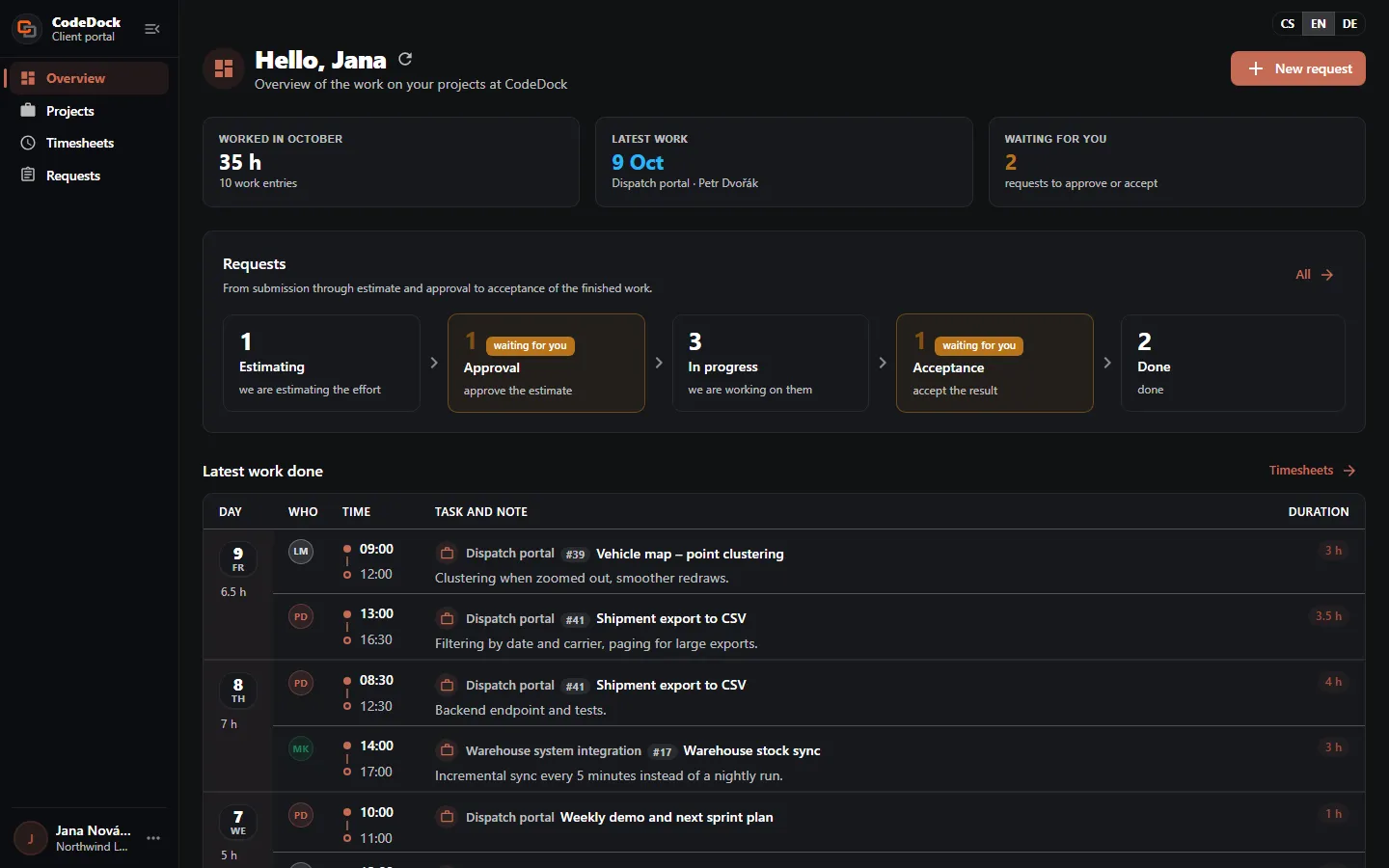
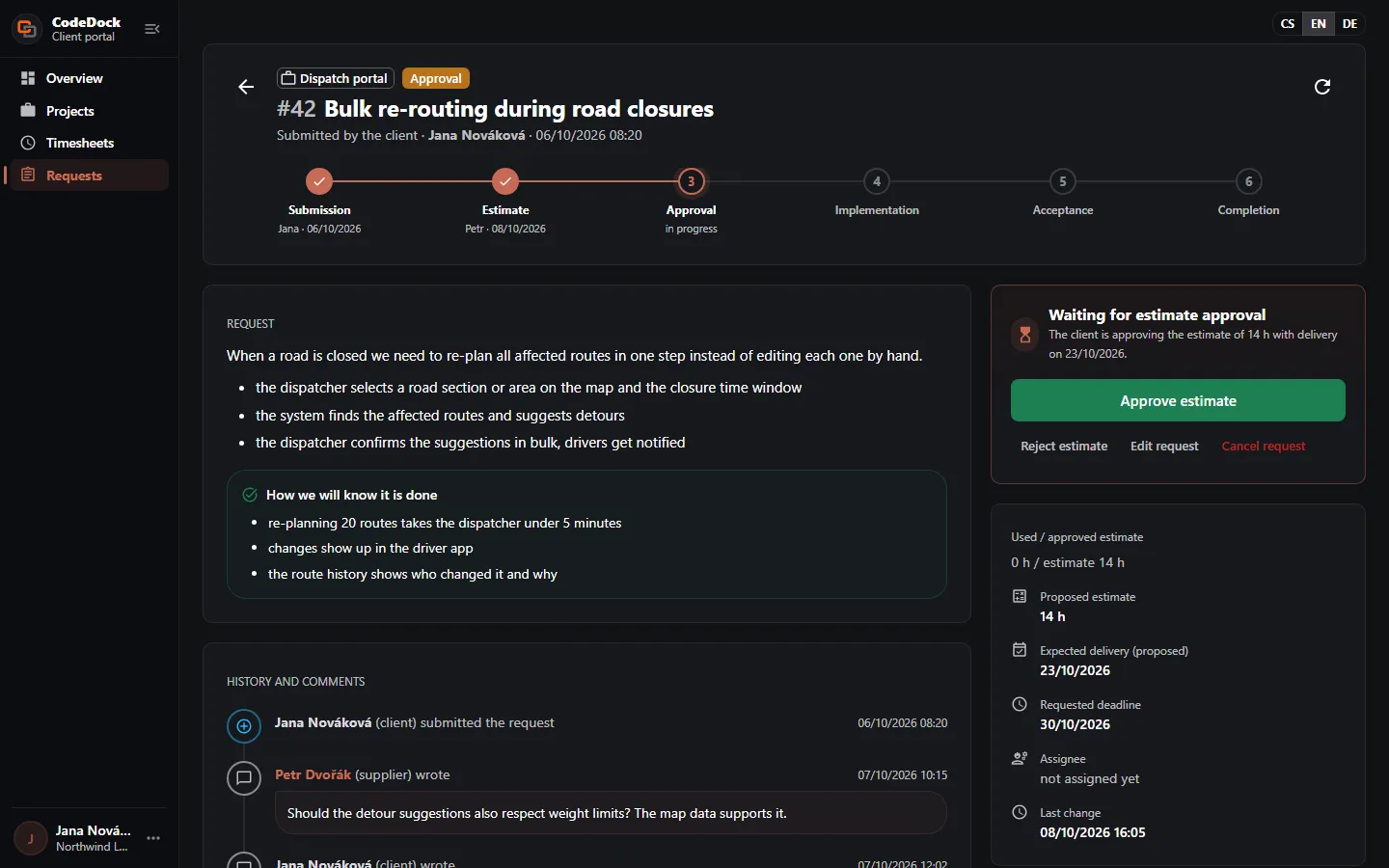
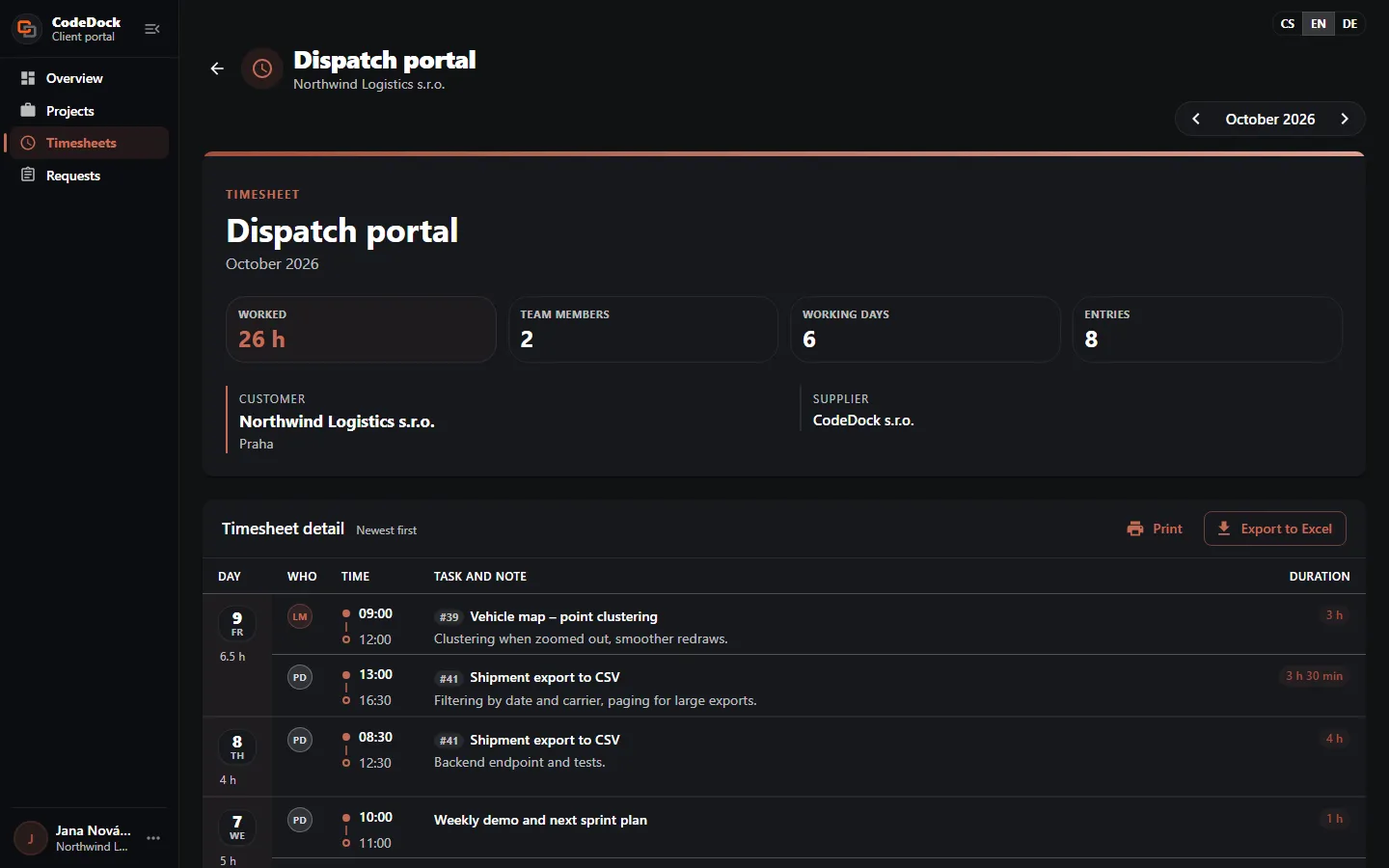
Screenshots use fictional demo data.
Something missing? Write to info@codedock.com
The first 30-min call is free. A paid audit (1–3 days, €600–1,800) is optional for deeper assessment of an existing system. Its cost is deducted if we continue the engagement.
Most commonly time & materials with monthly invoicing. Fixed budget makes sense for clearly scoped work (audit, specific migration, integration). We always tell you up front what things roughly cost — no nasty surprises.
Usually within 1–2 weeks from the first call. Architecture proposal within 48 hours. Critical incidents (P1) we can tackle within 24 hours of contact.
For 30 days after handover we fix bugs for free — if something we delivered fails. Beyond 30 days, either a retainer (monthly hour cap) or ad-hoc T&M.
The project is always led by a senior architect. For the build phase we bring specialists (frontend, DevOps, data) based on what the project needs. You never get a team of juniors without senior oversight.